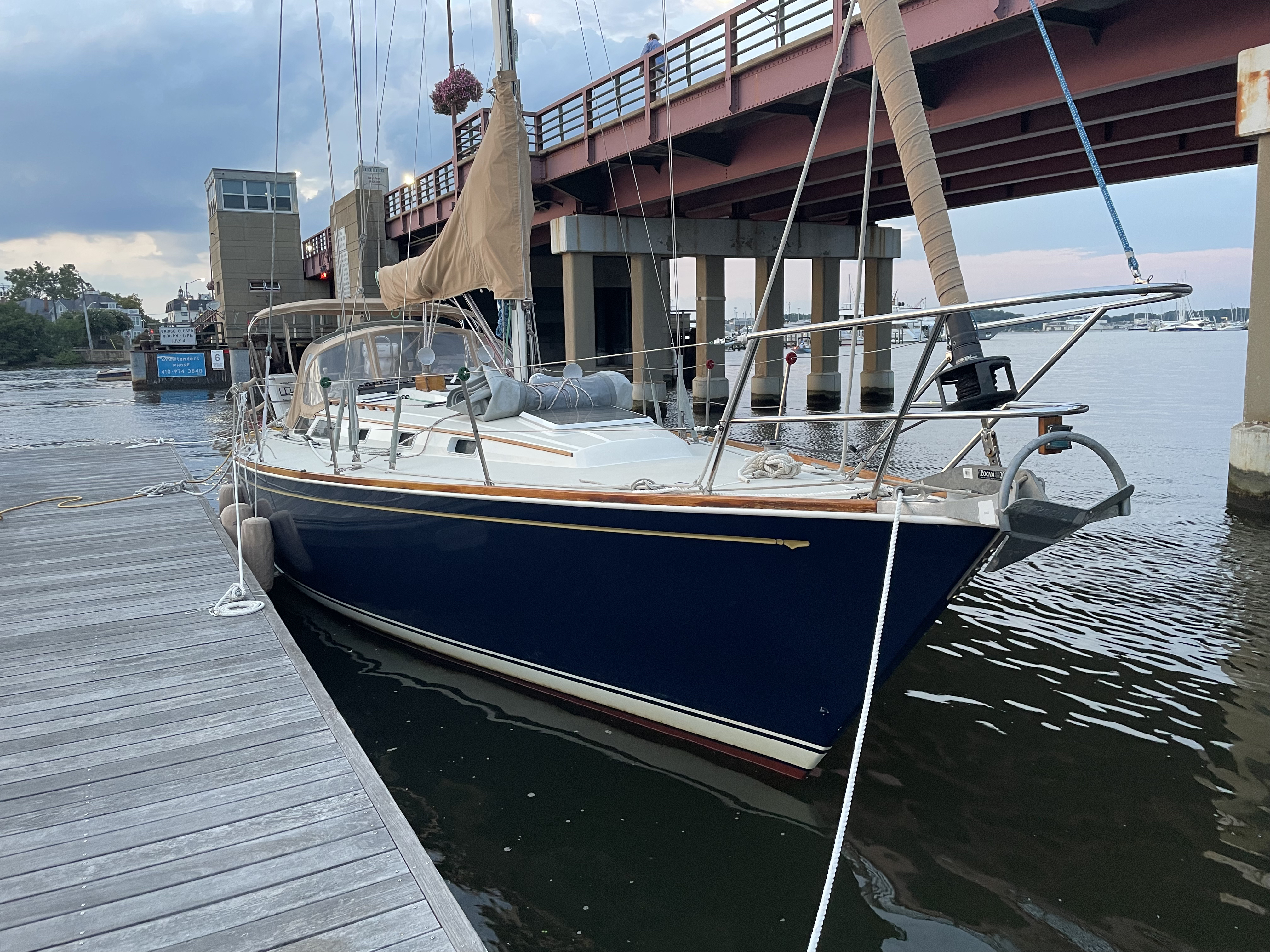
We are back in Annapolis! The summer was so busy between our cruise south, meeting friends in multiple locations, and work firing up again for me that I just didn’t have an ounce of bandwidth for blogging. But we’re back home now and getting back into a more normal routine. So lets blog!
Here is the sum up of our summer and our first 840 miles on the Sabre 38!!!
- Blue Moon’s Performance. Underway, the boat is an absolute dream under power or sail. The new 40 horsepower Yanmar is fabulous. It’s quiet, smooth and crazy powerful. The original 1988 owner’s manual quotes a typical cruise speed of 5.5 knots with the original Westerbeke 33. That’s about right – with a clean bottom our Sabre 42 with the Westerbeke 46 powered at 5.9 knots while burning about a gallon of diesel per hour. The computerized Yanmar on Blue Moon powers her along easily at a full 7 knots while burning around .7 gallons per hour. What’s more, running at those speeds there is a still a ton of power in reserve for headwinds or choppy seas. What a leap forward!
The boat sails superbly too. If we have more than 6-7 knots true wind and the breeze is on the beam or further forward, the boat is going 6-7 knots through the water. Any more wind and it’s going hull speed in the mid 7s. Basically it will go whatever the wind speed is if the wind is on the beam or forward. Incredible. - Dynamics under way. The Sabre 38 mkII was the last new Sabre Roger Hewson designed. Although the design language is generally very similar to the mid 80s Sabre 34/36/42 there is one big difference from the 42 (in particular): he carried a lot more beam forward on the ’38. Although the widest point of beam is in a similar position fore-and-aft, the forward sections of the 38 MKII are notably wider, with comparatively less topside flair. The result is more reserve buoyancy forward in this hull than I remember in the 42 (and waaayyyy more than the Hylas 54). The first time I came across choppy seas on Blue Moon I was leaving Portland (Maine) on a relatively calm day after a big blow the night before. Out in the Atlantic there was a big left over chop, and I was prepared to begin experiencing green-water-over-the-decks drama similar to what I had experienced on the 42 leaving Tangier Island on the Chesapeake in 2016. But it was not to be: as the first waves rolled in I was amazed to see the little 38 just bounce right over the top of them like a little cork! After hours powering into a steep chop maybe one wave climbed the bow high enough to reach my Rocna anchor, while exactly no green water washed over the deck. What’s more, the boat doesn’t pound while powering into chop like the 42 was prone to – although the 42 almost never pounded when sailing to weather in the same conditions. During the passage I heard maybe 2-3 half-hearted pounds, and the 38’s structure felt rock solid each time. Between the obviously solid construction and and the 38’s propensity to simply bob over waves, my immediate reaction to being at sea in the boat was “I would go anywhere in this boat in any weather.” The only negative consequence I can so far perceive to the 38’s hull form is more spray over the deck when sailing to weather. I can live with that tradeoff for sure.
- Living space below. During the summer I had occasion to go aboard two other Sabre 42s – one while fetching a bottle of CNG from a very generous member of the Sabre family that helped us out of a serious jam, and a second aboard a friend’s 42 in Port Jefferson. The 42 feels MUCH larger after having lived aboard the 38 for several weeks. The 38 hull form has a lot more sheer, but rather than achieving this with a raised bow, it’s almost as though the real difference was lowering the freeboard to a greater degree in the 38’s aft portions than Hewson did in the 42. The result is that one sits far higher above the waterline in the cockpit of the 42, and the aft sections of the interior (especially around the galley) feel much larger. The only notable practical benefit of this is much more counter space in the galley, something that Lisa deeply envied relative to the 38’s galley. The aft bunk is larger to, although the practical benefit of that is somewhat muted. Other than the reduced counter space in the galley, we never noticed the difference in interior space until we saw the boats back-to-back and never felt cramped in the 38.
Because the salon of the 42 is further forward – and because the 42 carries less beam forward – the salons of the two boats are essentially the same size. Walking further forward, one quickly realizes that the 38’s forward cabin is much better than the 42’s. This is only partly because the 38 does not offer the second head, which (when chosen – it was an option) takes up a bunch of the space of the 42’s forward cabin. We do not miss the second (forward) head at all on the 38, because having a sink in the forward cabin amounts to pretty much 90% compensation for the loss (even with two couples aboard!), and the extra forward cabin space is more than sufficient compensation. There are two other big changes: the beam being carried further forward and the doghouse being carried forward over the V-Berth make this forward cabin much larger and more useful than the 42’s. In fact this is the best forward cabin of the boats we have owned so far; it is at least as good as the Hylas 54’s was and it may actually be better. Seriously.
The summary is that we could not be happier with the boat! I am going to put up a separate post with some fun photos and videos from the summer.
 Rover's Blog
We own a Sabre 38 MkII as well and love it. we have started to believe that she is happiest when wind in over 20K. Thank you for a great analysis of this boat.
Holy shit! I am impressed! This is a very good sailboat! The forward head on the 42 clearly ends up a bit inefficient… But the under way efficiency is way more impressive!… All that is well covered! I want to look for a moment at the motoring performance; I expect that the Yanmar is lighter and provides better output than the older Mitsubishi based Westerbeke OEM engine… All in all, very nice find this Sabre turned out to be! Cheers!
The Yanmar is 40 HP and weighs 10 pounds less, I think. But it is also so big that it takes up the entire engine room and we have to run blower fan whenever it runs to cool the electrical stuff in there lol. It is much, much more powerful than the original and is also smooth and quiet. Its fantastic.