Category Archives: Tips & Tricks

Another Yacht Casualty That Teaches Lessons

Contrary to the narrator’s glowing review of this (lost) yacht’s crew, I see several situations that could have been handled much better by the leadership of this yacht, which reinforce learning lessons of other yachting casualties. Again, I post criticism not to shame a crew that have lost their yacht, but because I do not think the yachting community is well served by puff pieces like this one heaping praise on the yacht’s leadership. We cannot learn from causalities as a community unless we are brutally honest with ourselves and our colleagues about preventable mistakes that contribute to yacht losses that endanger both the yachts’ crews and rescue personnel. While I praise the yacht’s captain for his candor in relating the story, here are the major lessons I think we can all take from this story:

  1. At around 6 minutes into the video, the narration states that the main engine failed “due to sludge in the bottom of the tank being stirred up during all of the bouncing around.” It is unacceptable not to have verified the absence of contamination in the fuel tank(s) before departing Newport. The yacht was responsible for the lives of a full race crew going to Bermuda, and for a delivery crew returning. This is literally the first technical matter that must be addressed on any yacht heading out into the open sea. For more thoughts on clean fuel, see this and this.
  2. At around 6:14 in the video, the narrator relates that the captain says that he could not change the fouled fuel filters because he was not in a calm harbor. That assertion is completely unacceptable. The fouling of fuel filters is always a possibility at sea, and is in fact mostly likely to occur in a rough sea state. That is why it is imperative that all yachts putting out to sea have at least one crew technically capable of replacing both the pre fuel filter (“Racor”) and on-engine fuel filter in any sea condition. The failure of the main engine was therefore entirely preventable insofar as it was caused by fuel contamination, which never should have been present in the first place.
  3. The captain reports severe impacts when falling off of large seas. Technical leadership on a yacht should always go below to check for damage and rule out the ingress of water in such a situation, especially on an older wooden yacht. If that was done here, he does not report it in his narrative. Whether it was or was not done in this case, let’s all make that an integral part of our standard operating procedures in rough weather. On fiberglass boats, the on-watch should check for broken fiberglass tabbing around bulkheads and floor stringers, or signs of grid separation on more recent production boats.
  4. Starting at 9:40, the owner says he went below and handed the helm over to his daughter. He then discovered that all manner of items had fallen to the cabin sole in the rough seas, greatly impeding his ability to move around the cabin to investigate the source of water ingress. Whenever we are heading into rough weather, a watch must always be assigned to secure all loose items below deck. This story shows exactly why this step is table-stakes for proper blue water seamanship.

Again, no disrespect intended toward a yacht captain grieving the loss of his vessel, but let’s all take these stories to heart and learn from them. Like everyone else, I screw up regularly when operating boats. Each time I am reminded: a mistake is never shameful, only willfully ignoring the learning lessons of those mistakes would be.
How To Re Seal A Hatch Frame Correctly, And How To Screw It Up!

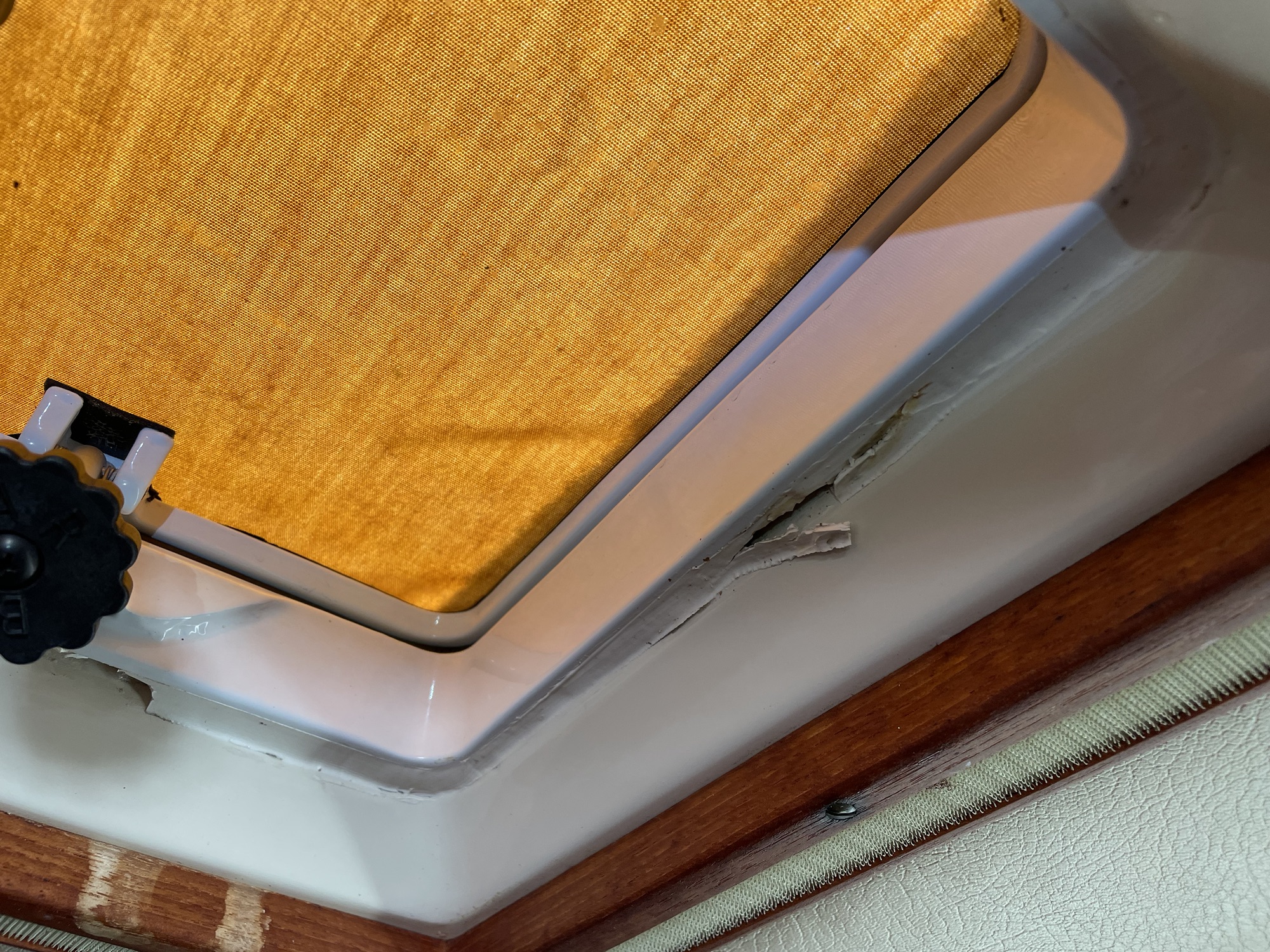
Another leak broke out on Blue Moon this past fall, once again caused by sloppy and inattentive work done by Hinckley Yacht Services up in Southwest Harbor, Maine. Under Blue Moon‘s prior ownership, all of the portholes and hatches on the boat were replaced a few years ago. Despite the recency of these installations, so far one porthole frame and the small deck hatch above the nav station have sprung leaks around the frame, in both cases due to inadequate preparation of the mating surfaces between the deck and the hardware. Operating on the assumption that the same (poor) process was followed for all of the deck hatches and portholes, I fully expect to have to re do all of the work Hinckley charged the prior owners many, many thousands of dollars to complete just a handful of years ago (we have the receipts!). The prior owners are wonderful people and had no reason to distrust Hinckley’s methods, particularly given the rates Hinckley charge. For the benefit of other Sabre owners, let’s walk through the right way to re bed portholes and hatches on a fiberglass boat and see where Hinckley cut corners and has thereby generated a ton of unnecessary work for us.

On both of my Sabres, white caulk was used to seal the gap between the underside of the hatch frames and the under-deck headliner. This is entirely for aesthetic purposes, as the last thing one would want to do is to trap water in this space that had already leaked past the seal at the deck. To remove Sabre hatches, begin by breaking the bond between this strip of sealant and the headliner to make the hatch easier to remove. In the photo above you can see the break being made.
Continue reading How To Re Seal A Hatch Frame Correctly, And How To Screw It Up!

Our Cruising Sailboat Buyer’s Guide!

It’s Annapolis Sailboat Show season once again! We thought it would be fun to create a video with guidance on how relatively new buyers can select the right cruising sailboat given their sailing objectives.

Editor’s note: around the 40 minute mark the audio has a mistake: the Island Packet 485 does not have a bobstay (although should be used around the bow as a result of the cleats’ location).

Interested in any of these models? Our reviews are linked here:

Jeanneau 409 / Sunsail 41

Sea Sprite 34

Hylas 54

Sabre 38 MKII

Not a cruising boat, but: J/88

Reader Q&A: Living and Working Aboard

By Rich

I got an email from a reader with the following questions about living and working aboard. I thought I would post my email response here in Q&A format to help any other readers that may have similar questions:

Question: What’s been your experience trying to work while living about your boat? Have you had significant issues with connectivity or power while cruising nearshore? Do you end up spending most of your workdays docked in marinas or are you able to anchor out and still effectively communicate with the outside world? How about sharing a space, even with separate cabins, with someone else trying to do their thing? Would having to listen to another person’s phone or video calls end up driving your shipmate nuts?

Continue reading Reader Q&A: Living and Working Aboard

Passage Making Cruisers: Adopt These In-Port Bilge Pump Checks!

By Rich

There are two fascinating difference between our prior boat, the Sabre 42 (and most similar coastal cruisers) and our current Hylas 54 from the standpoint of automatic bilge pumps. The first big difference: on our Sabre, a variety of sources would cause the (single) automatic bilge pump to run regularly quite apart from any leaks that would be alarming to the crew or a threat to the vessel. For example, rainwater would run down the center of the mast into the bilge which could cause the bilge pump to run periodically during rainy periods. Also, the Sabre’s air conditioning and refrigeration drained condensate directly to the bilge (neither of which were particularly desirable) which would trigger automated draining of the bilge by the pump. Whatever the cause, while aboard we regularly would hear the bilge pump run and therefore had an awareness that that the bilge pump worked.

Continue reading Passage Making Cruisers: Adopt These In-Port Bilge Pump Checks!

Lessons From a YouTube Casualty

By Rich

YouTube channels can be credited with generating excitement about sailing and bringing people into the sport, but those of us who have lived aboard cruising boats for extended spells know that they also paint an unrealistically rosy picture of what the cruising lifestyle is really about. We also know that in many cases YouTubers set bad examples – for example by choosing to cross the Atlantic in a cruising catamaran dangerously late in the season as a publicity stunt, or filming themselves offshore prancing around on deck on the ocean with no jacklines, let along tethers or PFDs. Continue reading Lessons From a YouTube Casualty

We Anchored Beam-To After The Gale

By Rich

After the gale passed yesterday, we found the breeze shifting to the west and easing somewhat, blowing around 20 with gusts to the upper 20s. With the right shift we found a terrible problem with swells bending around the northern corner of the island and coming to violently roll us on the beam. Some months ago Brian send me a link to a YouTube video showing how to rig a “swell bridle” for this situation. The technique involves tying a long line to the anchor chain with a rolling hitch, running it aft to the transom, and then easing out the chain enough that effectively you wind up a gigantic bridle that will hold the boat in the direction you choose (based on how much chain you let out from the bow). We decided to try it out, and it worked great! We were able to point the bow straight into the waves and be far more comfortable even though the waves coming off the Sound were so big they actually caused the boat to pound lightly on occasion! Check out the results in these videos:


Continue reading We Anchored Beam-To After The Gale

An Object Lesson In Keeping Diesel Clean

By Rich

It’s a terrible joke but I’ll make it again: marine diesel engines always fail at the worst time. From an engineering standpoint, this is a bad joke because there is a perfectly good reason why engines choose rough weather to fail: big seas stir up the asphaltenes or blobs of microbial growth, which then get sucked up into lines and filters. Many boat owners like to blame old, dirty fuel tanks or having “gotten bad fuel” at their last fill up, but the reality is that keeping fuel clean requires constant vigilance even on new boats. The ship’s log our our Hylas 54, Rover, show that she was experiencing engine failures due to clogged fuel filters when she was only a year old. Below is a great a video from Distant Shores TV showing they had the exact same experience on their one year old boat – and, as always, the engine failure occurred in an choppy inlet, which is when they always do. If you watch the video all the way through you will see that a terrible design flaw in Southerly’s fuel plumbing directly contributed their failure too.

How To Prevent Incidents Like This Continue reading An Object Lesson In Keeping Diesel Clean

Ever Struggle To Get a Dockline On A Far Away Piling? Rig A Heaving Line

By Rich

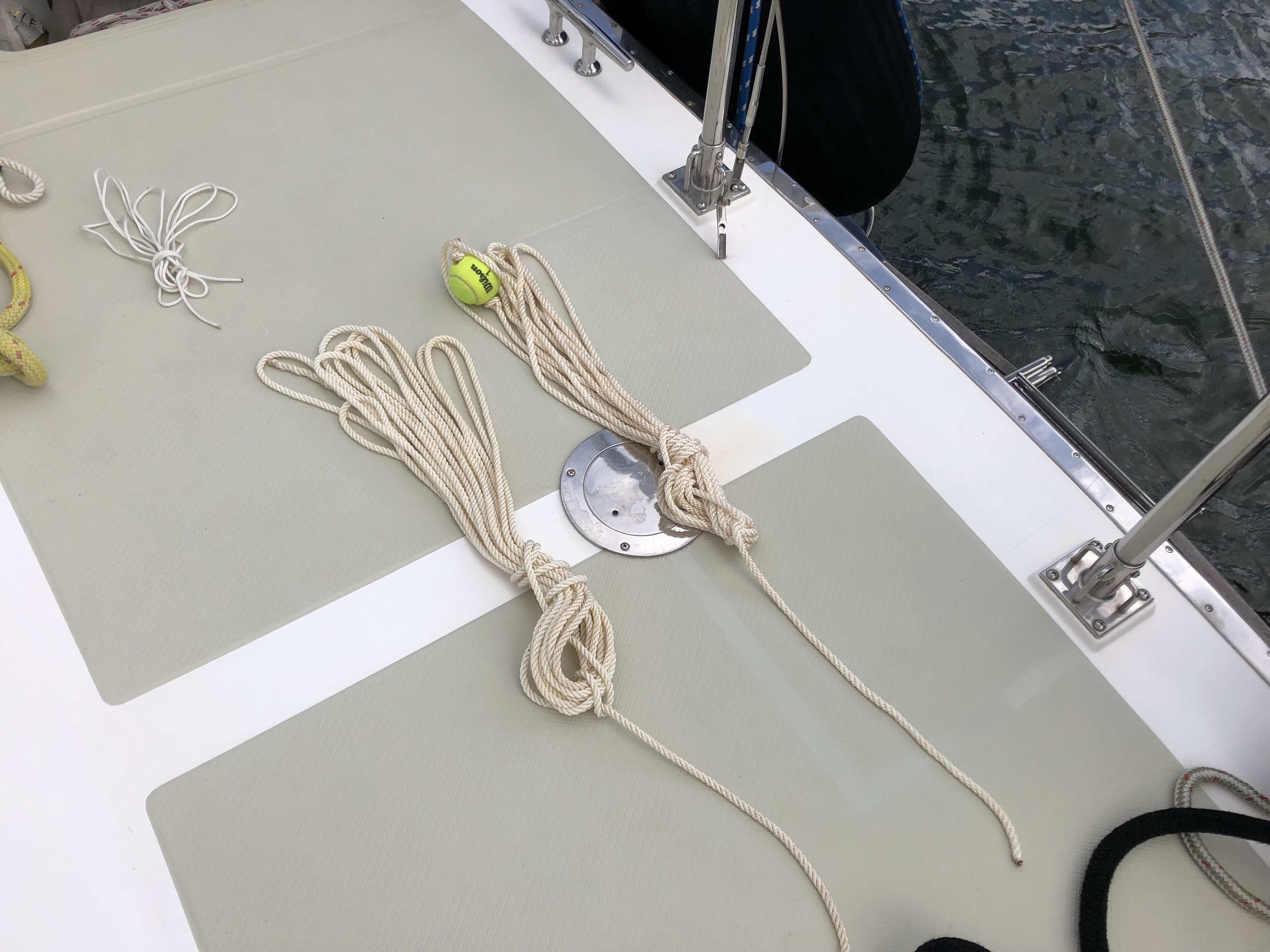
Don’t you hate it when you want to add a dockline to one corner of your boat, but the nearest piling is 15 feet away and much too tall to throw a line over it? On our Hylas 54 we found the prior owners had rigged heaving lines to solve the problem. Heaving lines are relatively light and small, but long lines with a weight on one end. Here’s what ours look like:

Continue reading Ever Struggle To Get a Dockline On A Far Away Piling? Rig A Heaving Line